
Laundry Rack for Families: What Changes With More People ?
Choosing a Laundry Rack for Families
Choosing a laundry rack for families is a different exercise from picking one for a couple. The washing does not simply double when a household grows, because towels, bedding, school uniforms and sports kit all arrive on their own schedule. So the rack that felt generous for two people starts to feel cramped within a year.
This guide walks through what actually changes as a household grows, and how to size a rack so it still works in five years. The short answer is that capacity, pole count and drying speed all need to rise together, yet most families only think about one of the three.
How Much Laundry Does a Family Really Generate?
A single person produces roughly two loads a week. Couples typically produce three or four. A family of four, however, usually lands between seven and ten loads, and that number climbs again once children play sport or swim.
Here is the pattern most Singapore households recognise:
The jump between two people and four is not double. It is closer to triple, because children change clothes more often and bedding rotates faster.
Why a Laundry Rack for Families Needs More Than Extra Poles
More poles help, but they only solve half the problem. Three other things change at the same time.
1. Total Weight Rises
Wet towels and bedsheets are heavy, so a frame rated for 40kg starts to feel marginal once a family loads it properly.
2. Drying Speed Matters More
A couple can afford a load that dries overnight. A family cannot, because the next load is already waiting in the machine.
3. Spacing Becomes Critical
Crowded poles trap humid air between garments, and clothes then dry slowly no matter how strong the fans are.
Sizing a Laundry Rack for Families: The Three Numbers
Work through these three figures before you shop, and the shortlist narrows quickly.
1Load Capacity
Aim for 50kg if your household is four or more. That rating carries two to three full loads at once, which is what a family actually needs on a Sunday.
A 40kg frame suits couples and small households comfortably. It simply runs out of headroom once bedding joins the rotation.
2Pole Count and Spacing
Eight poles give far more usable hanging space than six, and the gaps between them matter as much as the number. Wide spacing lets warm air pass between garments, so everything dries evenly.
3Frame Span
Measure your service yard wall to wall, then subtract about 10cm for clearance. Frames extend from roughly 100cm up to 220cm, so match the span to the room rather than the other way round.
Why Drying Speed Decides a Laundry Rack for Families
For a couple, drying speed is a convenience. For a family, it decides whether laundry piles up.
Fans and heat are what actually shorten the cycle. Six fans pushing air at 8m/s across four heaters at 60 degrees will finish a full load in roughly one to three hours. Four fans at 6m/s take noticeably longer, which is fine for three loads a week and frustrating at ten.
Singapore's humidity makes this sharper still. The Meteorological Service Singapore records relative humidity above 80% for much of the year, so passive drying is slow whatever rack you own.
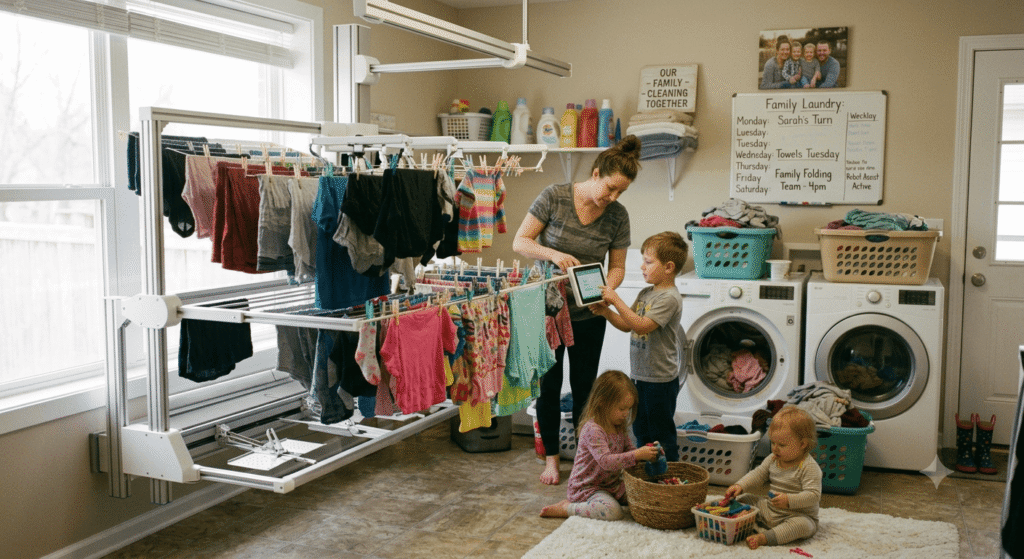
Choosing a Laundry Rack for Families of Different Sizes
Different homes hit different walls, so here is a practical guide.
Couples
A 40kg frame with four fans is comfortable. Look at the Swift Pro or a similar entry model.
Growing Families
Once a third person joins, step up to 50kg. Bedding is usually what forces the upgrade rather than clothing.
Families of Four
This is where six fans start to earn their price. The Platinum Pro 3.0 is the common landing point for exactly this reason.
Large Households
Daily laundry needs the fastest cycle available, plus the full 50kg rating and a wide frame span.
Mistakes Families Make Most Often
Four errors show up again and again, and all four are avoidable.
- Buying for today. A rack bought for a couple rarely suits the same home three years later.
- Ignoring bedding. King-size sheets need width and drape, not just weight capacity.
- Overloading the poles. Crowding cancels out the airflow you paid for.
- Skipping the measurement. Yard widths vary enormously, even within the same block.
A free on-site measurement removes the guesswork entirely, and it takes about fifteen minutes.
Making a Laundry Rack for Families Work Harder
Even the right rack performs better with a little routine.
- Shake each garment before hanging, since creases trap moisture.
- Alternate heavy and light items along the poles so air circulates.
- Hang bedsheets folded over two poles rather than bunched on one.
- Run the fan-only mode for ten minutes after the cycle to finish the collars and cuffs.
- Keep the yard door open during drying so humid air has somewhere to go.
When Is It Time to Upgrade?
Households rarely plan the upgrade. It usually arrives after a wet week when the washing simply stops fitting.
Watch for these four signals:
Any two of those together usually mean the frame is undersized rather than faulty. Upgrading the rack is far cheaper than living with a permanent backlog, especially since installation and removal of the old unit are included.
Frequently Asked Questions
What capacity does a family of four need ?
Around 50kg across eight poles. That handles two to three loads at once, including bedding.
Is a 40kg rack enough for three people ?
Usually, though it becomes tight once bedding and towels are in the rotation. Many three-person homes upgrade within two years.
How many loads can one rack dry per day ?
With heated airflow, two to three cycles a day is realistic, since each load takes roughly one to three hours.
Do bigger families need a wider rack ?
Width helps, but pole count and spacing matter more. A wide frame with crowded poles still dries slowly.
Can children operate the rack safely ?
Yes, with supervision. Every model has obstacle detection that halts the motor when something blocks the path.
Will a family rack fit an HDB service yard ?
Almost always. Compact frames start at a 100cm span, and a free measurement confirms the fit before you buy.